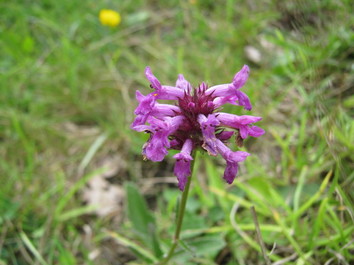
 Betony
Some areas of the Commons have lost their wildflower diversity.
Some areas of the Commons were ploughed during the war, and others have been historically under-managed. Consequently, some parts of the Commons are now rather herb-poor, and one of the main aims of the Higher Level Stewardship agreement is to restore some of the lost wild-flower diversity in these areas. This can be achieved by 'seed enhancement' - spreading locally-harvested wildflower seed onto species-poor areas.
Funding through the Higher Level Stewardship, agri-environment scheme, has enabled harvesting and sowing of wild flower seed onto different areas of the commons. 2014 saw 6 hectares sown, 2015 had 5 hectares, 2016 was another 5 hectare area, 2017 had small areas, totaling approximately 1 hectare, 2018 had nearly 6 hectares and an area of 5 hectares was sown in autumn 2019. This is a total of approximately 28 hectares of grassland improved for wildflowers.
Some areas of the Commons were ploughed during the war, and others have been historically under-managed. Consequently, some parts of the Commons are now rather herb-poor, and one of the main aims of the Higher Level Stewardship agreement is to restore some of the lost wild-flower diversity in these areas. This can be achieved by 'seed enhancement' - spreading locally-harvested wildflower seed onto species-poor areas.
Funding through the Higher Level Stewardship, agri-environment scheme, has enabled harvesting and sowing of wild flower seed onto different areas of the commons. 2014 saw 6 hectares sown, 2015 had 5 hectares, 2016 was another 5 hectare area, 2017 had small areas, totaling approximately 1 hectare, 2018 had nearly 6 hectares and an area of 5 hectares was sown in autumn 2019. This is a total of approximately 28 hectares of grassland improved for wildflowers.
Inglestone Common, alive with insects